
Restoration Services in Cordelia, CA
Water, fire and smoke, mold, storm, sewage, and rebuild work for Cordelia property owners. Trusted since 2005.
Cordelia sits at the southwestern edge of Fairfield where Interstate 80 meets Interstate 680, and it is defined by wind. The Cordelia gap is one of the primary channels through which marine air moves inland from the Carquinez Strait, and anyone who has driven that stretch of freeway on a windy afternoon understands what that means for buildings.
Finishing Touch HS serves Cordelia as part of our immediate Fairfield service footprint. The wind exposure here changes what we look for on storm and water losses, and we approach roof and envelope assessment differently in Cordelia than in a sheltered inland neighborhood.
Geography and conditions in Cordelia
Cordelia occupies the low pass between the Vaca Mountains and the hills above Benicia, opening south toward Suisun Slough and the Carquinez Strait. That geometry accelerates wind through the area consistently, not just during storms.
Elevation ranges from low, near-marsh ground on the south side to hillside development on the north and west. Green Valley Creek and associated drainage run through the area toward the slough.
The proximity to the marsh on the south side raises local humidity and groundwater relative to the hillside neighborhoods only a mile or two away, so two Cordelia properties can have meaningfully different moisture profiles.
Local building stock
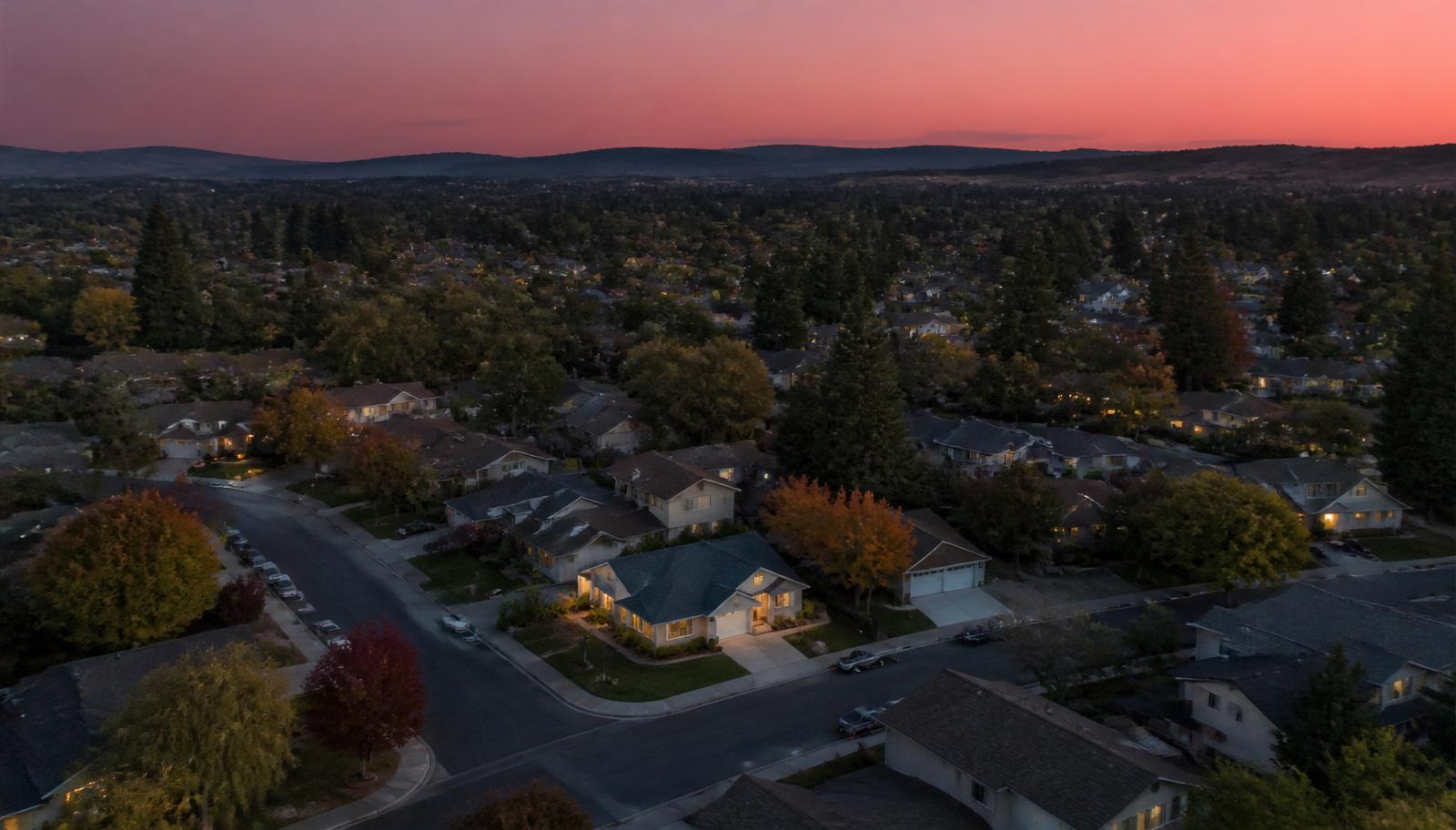
Much of Cordelia's residential development dates from the 1980s through the 2000s, with substantial tract and semi-custom construction on sloped and terraced lots.
Hillside properties in the area commonly have engineered drainage, retaining structures, and multi-level layouts, all of which create specific water intrusion paths when drainage becomes blocked or overwhelmed.
Older Cordelia near the original village core includes a smaller stock of early housing with the maintenance considerations that come with age.
Risk profile for Cordelia
Wind-driven rain is the distinguishing water risk in Cordelia. Rain arriving nearly horizontally gets past window head flashing, siding laps, and roof edge details that would never leak under vertical rain, and it does so on the exposed elevations rather than uniformly around a building. On sloped lots, the second major category is runoff, where sheet flow from uphill finds garage thresholds, lower-level doors, and foundation penetrations. Interior supply line and appliance failures occur at the same rate as anywhere else.
Cordelia has grassland exposure on its surrounding hills, and the same wind that defines the area is what makes a grass fire dangerous here. Wind-driven fire in dry annual grass moves quickly across open ground toward the wildland edges of development. Structure fires follow ordinary patterns, though wind affects both fire spread and smoke movement through a building, and post-fire smoke scopes in windy conditions frequently extend further than expected.
Cordelia splits into two mold profiles. Low-lying, marsh-adjacent properties on the south side see elevated groundwater and crawlspace moisture similar to Suisun City. Hillside properties see mold driven by drainage failures and wind-driven rain intrusion that saturates wall assemblies repeatedly across a winter. In both cases the recurring theme is that the moisture is intermittent, arriving with storms rather than continuously, which makes it harder to trace and easier to ignore until growth is established.
This is the highest wind exposure area we serve. Roof edges, ridge caps, tile and shingle fastening, fencing, gutters, and rooftop equipment all take sustained loading here. Storm damage in Cordelia is disproportionately envelope damage, and the follow-on water intrusion through those failures is what produces the interior loss. Post-storm attic inspection is particularly worthwhile here, because a lifted shingle course or displaced flashing may not show inside until several storms later.
Cordelia's newer infrastructure means fewer aging lateral failures than older Fairfield neighborhoods, and backups here more commonly stem from blockages, ejector pump failures in multi-level homes, and heavy rain infiltration in the lower-lying areas near the slough.
Commercial property in the area
The Cordelia and Green Valley business parks form one of the county's larger commercial concentrations, with office, light industrial, and distribution uses, plus the retail and hospitality clustered around the Interstate 80 and 680 interchange. Wind exposure makes rooftop equipment, flat roof membranes, and parapet details a recurring commercial concern, and those are the elements we check first after a wind event.
Response and access
Cordelia is minutes from our Fairfield base with direct freeway access. We treat wind-driven intrusion as the default hypothesis on storm-season losses here and inspect exposed elevations and attic spaces accordingly.
- Interstate 80 and Interstate 680 interchange
- Cordelia and Green Valley business parks
- The Cordelia wind gap toward the Carquinez Strait
- Green Valley Creek drainage
Services we provide in Cordelia
Nearby towns we serve
Answers to common questions
Restoration help in Cordelia
We perform the work ourselves, we document it for your carrier, and we tell you plainly what does and does not need to be done. Trusted since 2005.