Restoration Services in Fairfield, CA
Water, fire and smoke, mold, storm, sewage, and rebuild work for Fairfield property owners. Trusted since 2005.
Fairfield is our home base and the town whose building stock we know in the most detail. It is the Solano County seat, it sits at the junction of Interstate 80 and Highway 12, and it has grown in distinct waves that each left behind their own construction era and their own characteristic failure modes.
Because we are based here, Fairfield gets the shortest response window of anywhere we serve, and that matters more than any other single factor in how a water or fire loss turns out. Finishing Touch HS has worked on Fairfield property since 2005, as a direct provider performing the work with our own people rather than dispatching a subcontractor.
Geography and conditions in Fairfield
Fairfield sits in the Suisun Valley basin, bounded by the Vaca Mountains to the north and west and the Suisun Marsh to the south. That position produces the single most defining local weather feature, the Delta breeze, which funnels marine air inland through the Carquinez and Suisun gaps almost every summer afternoon and drives sustained wind through winter storm systems.
The city drains toward Suisun Slough through a network of creeks including Ledgewood Creek, Laurel Creek, and Union Avenue drainage channels. In an ordinary rain year those channels handle runoff without incident. In an atmospheric river event, where several inches fall in a day onto ground already saturated from the previous storm, low-lying areas near those channels and older neighborhoods with undersized storm drains see water where it does not normally go.
Elevation varies more than people expect for a valley city, from near sea level at the marsh edge to several hundred feet in the foothill neighborhoods on the northwest side. That range means two properties a few miles apart can face completely different water intrusion and wildfire exposure profiles.
Local building stock
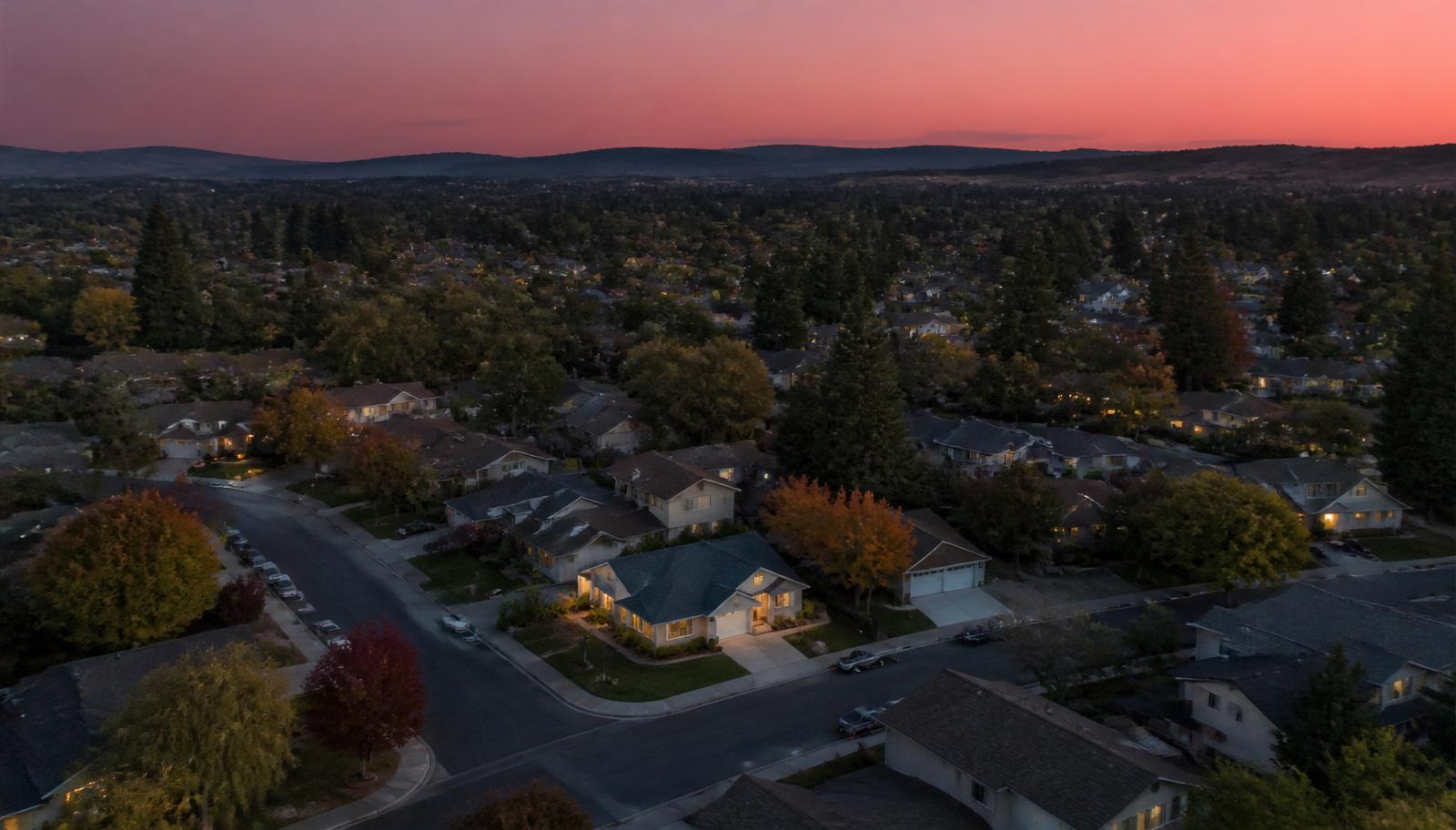
Central Fairfield includes a substantial stock of mid-century homes built between the 1950s and 1970s, much of it tied to Travis Air Force Base growth. These homes commonly have original cast iron or galvanized drain lines nearing the end of their service life, slab-on-grade construction with copper supply lines that develop pinhole leaks, single-pane or early dual-pane windows with failing seals, and minimal attic insulation by current standards.
The 1980s through early 2000s expansion produced large tract neighborhoods on the north and east sides. These homes tend to have two-story layouts with upstairs laundry rooms and bathrooms, which is the specific configuration that turns a supply line failure into a two-floor loss, and they frequently have builder-grade angle stops and washing machine hoses that were never replaced.
Newer construction in Fairfield is tighter and better insulated, which is good for energy performance and creates a different moisture profile. A tight building that gets wet dries more slowly without mechanical intervention, and interior humidity from ordinary occupancy has fewer paths out, so bathroom ventilation performance matters far more than it did in a leaky 1960s house.
Risk profile for Fairfield
Fairfield water losses cluster into three predictable groups. Supply line and appliance failures happen year round and are the most common by volume, with second-floor laundry rooms and water heaters in interior closets producing the most expensive versions. Winter storm intrusion concentrates in December through March, arriving through roof flashing, clogged gutters overflowing behind fascia, and window head details that fail under wind-driven rain rather than vertical rain. Slab leaks are a real category in the mid-century housing stock, where copper under slab has been in service for fifty years or more, and they often present first as an unexplained water bill increase or a warm spot on the floor rather than as visible water.
Fairfield's fire exposure has two distinct components. Interior fires follow the usual pattern, dominated by kitchen origins and electrical faults in older panels, and in the mid-century housing stock aging wiring and original panels are a genuine factor. The second component is regional wildfire smoke. Fires in the Vaca Mountains, in Napa County, and across the broader North Bay have repeatedly pushed heavy smoke into Fairfield for days at a time, and buildings pull that smoke in through HVAC intake, attic venting, and ordinary infiltration. Properties can require full smoke remediation, duct decontamination, and odor treatment without any flame ever reaching the structure.
The Delta breeze and dry summers mean Fairfield is not a chronically humid climate, and that is generally protective. The mold problems we find here are almost always tied to a specific moisture source rather than to ambient conditions. The recurring culprits are unresolved winter water intrusion in attics and exterior walls, bathrooms without functioning exhaust ventilation in the mid-century stock, crawlspaces that hold standing water after a wet winter, and slab leaks that soak subfloor and wall base for months before discovery. Because the ambient air is dry, homeowners frequently assume they cannot have a mold problem, which is exactly why these situations run long before anyone investigates.
Winter storms in Fairfield combine sustained wind with intense but compressed rainfall. The wind component is the part people underestimate. Delta wind works at roof edges, ridge caps, and fencing continuously, and by the time a strong system arrives, marginal roof details have already been loosened. Rain then arrives horizontally and finds those details. Add ground saturated from prior storms and you get the second tier of problems, including drainage backing up against foundations, water entering garages and crawlspaces, and trees failing in soil that no longer holds their root plates.
Older central Fairfield neighborhoods carry the highest sewage backup exposure, with clay and cast iron laterals subject to root intrusion from mature street trees and to joint separation from decades of ground movement. Backups concentrate during heavy rain when infiltration raises flow in the collection system. Properties with fixtures below street level, including converted garages and older single-story homes on low lots, face the greatest risk and benefit most from a backwater valve.
Commercial property in the area
Fairfield's commercial base includes the Solano Town Center retail corridor, the Green Valley and Cordelia business parks, food and beverage manufacturing including the well-known operations off Highway 12, medical and professional offices, and a substantial hospitality cluster serving Interstate 80 traffic. Each has its own restoration priority. Retail cares about reopening floor area, food production cares about contamination control and documentation, offices care about records and workstations, and hospitality cares about getting rooms back in inventory. We phase commercial work around whichever of those drives the loss.
Response and access
Fairfield is where our crews and equipment are based, which means the shortest mobilization time we offer anywhere. Interstate 80 and Highway 12 give us direct access to nearly every part of the city, and we know which neighborhoods have access constraints, which have older infrastructure, and which sit low enough that storm season deserves a proactive look.
- Solano County seat and Solano Town Center retail corridor
- Interstate 80 and Highway 12 junction
- Suisun Valley agricultural area to the northwest
- Ledgewood and Laurel Creek drainage corridors
Services we provide in Fairfield
Nearby towns we serve
Answers to common questions
Restoration help in Fairfield
We perform the work ourselves, we document it for your carrier, and we tell you plainly what does and does not need to be done. Trusted since 2005.