Odor Removal in Vacaville, CA
Source identification and true neutralization, not masking. Performed directly by our own crews for Vacaville homes and businesses.
Odor Removal in Vacaville is shaped by conditions that do not apply evenly across Solano County. Low ambient humidity means chronic mold conditions are less common in Vacaville than in the marsh-adjacent cities, but that same dryness means moisture events go unnoticed longer. The mold we find here is typically well-established growth from a slow leak or a hillside runoff intrusion that persisted for months in a crawlspace or wall cavity. Bathrooms with poor ventilation and slab leaks in the older stock account for most of the rest.
The building stock matters as much as the weather. Vacaville expanded significantly from the 1970s onward, and much of the housing stock is tract construction from the 1970s through the 2000s, with a large volume of two-story homes containing upstairs bathrooms and laundry rooms. That construction profile changes what we expect to find once an assembly is opened, and it changes the sequence of the work rather than just the paperwork on it.
Vacaville occupies the transition between the Vaca Mountains and the flat agricultural plain running east toward Dixon. Alamo Creek and Ulatis Creek drain through the city, and both are the focus of storm-season attention because they carry runoff from the hills directly through developed areas. For odor removal specifically, that geography determines both how a loss develops and how quickly a building recovers once mitigation begins.
Vacaville is a short run up Interstate 80 from our Fairfield base. We plan hillside work around access and drainage conditions, and during fire season we expect smoke-related scopes across the whole city rather than only at the interface.
Vacaville has a substantial commercial and industrial base, including the biotechnology and life science campuses on the east side, the Vacaville Premium Outlets and associated retail, distribution and logistics facilities along the Interstate 80 corridor, and a healthcare cluster. Life science and healthcare facilities carry the strictest contamination and documentation requirements, and retail and distribution operations prioritize square footage returned to service.
Why Vacaville properties see this loss
Vacaville occupies the transition between the Vaca Mountains and the flat agricultural plain running east toward Dixon. Alamo Creek and Ulatis Creek drain through the city, and both are the focus of storm-season attention because they carry runoff from the hills directly through developed areas.
The city sits far enough inland to lose most of the Delta breeze moderation that Fairfield and Suisun City get, which means hotter summers, lower ambient humidity, and a different indoor moisture dynamic. Buildings here run drier, which reduces baseline mold pressure and increases the significance of any single moisture event, because occupants are less likely to suspect a problem.
The western and northern edges of the city meet undeveloped grassland and oak woodland, which is the wildland urban interface that defines the local fire exposure.
Fire and smoke residue is the most persistent odor category, because combustion products penetrate porous material and coat every surface air touched, including inside wall cavities and ductwork.
Pet urine is the most common residential odor problem and the most underestimated. It penetrates carpet, pad, subfloor, and the base of framing, and crystallized salts reactivate with humidity, which is why the smell returns every summer even after cleaning.
Microbial odor from mold and from long-term moisture is an indicator of an active or recent condition rather than a standalone problem, and treating it without addressing the moisture is treating a symptom.
Biological and decomposition odors, along with sewage events, require source removal and disinfection before any air treatment is meaningful.
What the work involves
The first step is always finding where the odor actually lives. Smoke odor lives in porous materials, insulation, framing, ductwork, and the underside of surfaces air touches. Pet odor lives in carpet pad, subfloor, and framing at the base of walls. Mold odor lives inside the assembly holding the moisture. Sewage odor lives in the porous material contaminated water contacted and in the traps and lines that let sewer gas in.
Once located, treatment follows a hierarchy. Remove the source material where removal is possible, because nothing outperforms removal. Clean thoroughly where the material stays. Seal where the material stays and cannot be fully cleaned, particularly framing and subfloor. Then, and only then, use air treatment to address residual airborne and surface-bound odor.
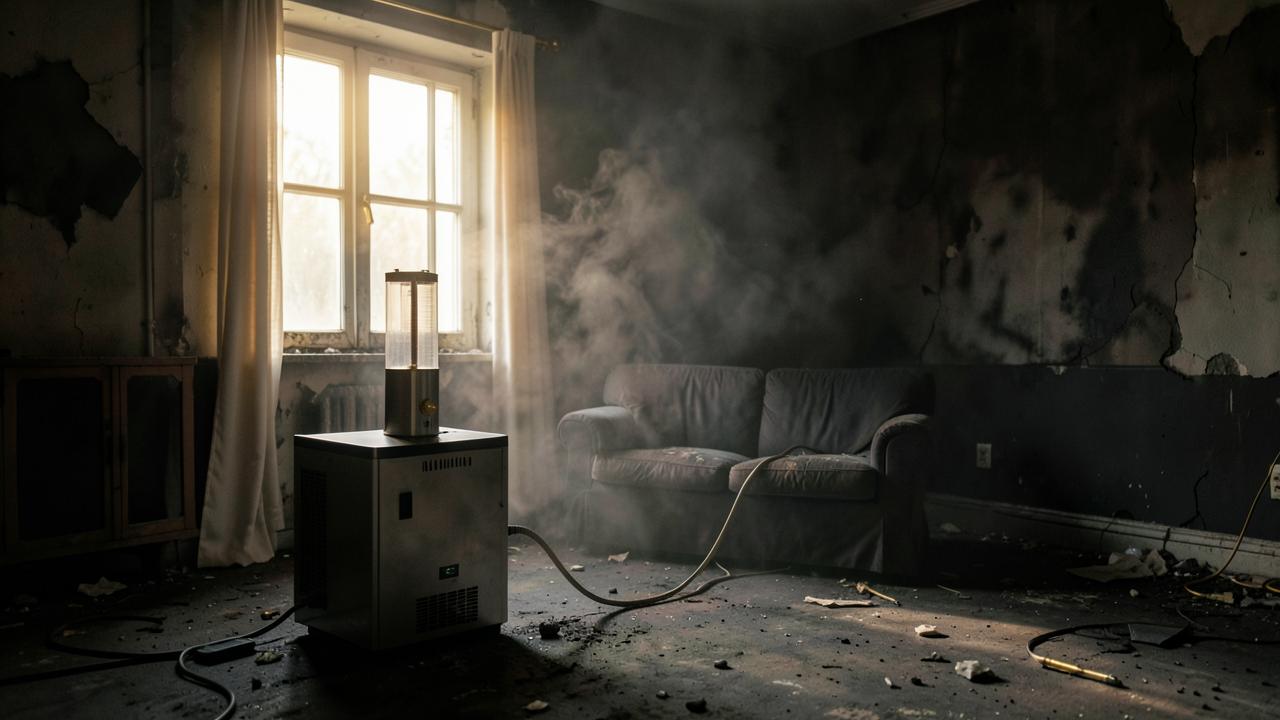
Air treatment options include hydroxyl generators, which can operate in occupied spaces and work more slowly, ozone, which is faster and more aggressive but requires unoccupied space and careful handling, and thermal fogging, which follows the same paths smoke followed and reaches voids that surfaces cleaning cannot. Which one is right depends on the odor, the material, and whether people are in the building.
Warning signs
- An odor that returns when heating, cooling, or humidity rises
- Smell that is strongest at floor level, indicating subfloor or pad involvement
- Odor that returns specifically when the HVAC system cycles
- Smell that comes back through fresh paint within weeks
- Persistent odor in a room with no visible damage
- Odor that is noticeable when entering the building but fades as you acclimate
Heat and humidity are diagnostic tools. Odor compounds volatilize more readily as temperature and humidity rise, so a building that only smells on warm damp days still has untreated source material. Verification should always be done under those conditions, not on the most favorable day.
Our process in Vacaville
- Step 1Source identification
We locate the material holding the odor using inspection, moisture readings, UV inspection for urine contamination, and systematic elimination room by room and assembly by assembly.
- Step 2Source removal
Where the odor-holding material can be removed, it is. Contaminated pad, saturated subfloor sections, affected insulation, and unsalvageable porous contents come out.
- Step 3Deep cleaning
Remaining surfaces are cleaned with chemistry matched to the odor type, since a product that neutralizes protein odor is not the product for smoke residue.
- Step 4Sealing
Framing, subfloor, and other retained porous surfaces are sealed with an appropriate odor-blocking primer so residual compounds cannot continue to off-gas into the space.
- Step 5HVAC decontamination
Ductwork and air handler components are cleaned, because a contaminated system will reintroduce odor to every treated room the moment it runs.
- Step 6Air treatment
Hydroxyl, ozone, or thermal fogging is selected based on the odor type, material, and occupancy, and run for the duration the situation requires rather than a fixed default.
- Step 7Verification under load
We verify with heat and humidity raised, which is when odor reveals itself, rather than testing on a cool ventilated building and calling it complete.
Residential and commercial
For homes, we work through the affected areas in sequence, are candid about which contents will hold odor permanently, and address pet-related contamination at the pad and subfloor level rather than treating it as a carpet cleaning problem.
For commercial spaces, odor is a customer-facing problem, so we prioritize public areas, schedule ozone treatment during closures, coordinate HVAC operation with facilities, and document the process for property management or ownership records.
Vacaville has a substantial commercial and industrial base, including the biotechnology and life science campuses on the east side, the Vacaville Premium Outlets and associated retail, distribution and logistics facilities along the Interstate 80 corridor, and a healthcare cluster. Life science and healthcare facilities carry the strictest contamination and documentation requirements, and retail and distribution operations prioritize square footage returned to service.
Local building stock and what it changes
Vacaville expanded significantly from the 1970s onward, and much of the housing stock is tract construction from the 1970s through the 2000s, with a large volume of two-story homes containing upstairs bathrooms and laundry rooms.
Browns Valley and the hillside neighborhoods on the west side include larger custom and semi-custom homes on sloped lots, where drainage, retaining, and hillside runoff management are ongoing considerations and where wildfire exposure is highest.
Older central Vacaville near the historic downtown includes early and mid-century homes with raised foundations, original plumbing, and the maintenance profile that comes with that age.
Timeline and response
Simple odor situations resolve in one to three days including treatment time. Smoke odor across a residential floor generally runs one to two weeks alongside the cleaning scope. Pet contamination requiring pad and subfloor work depends on the affected square footage. Verification adds time deliberately, because rushing it is how the problem comes back.
Vacaville is a short run up Interstate 80 from our Fairfield base. We plan hillside work around access and drainage conditions, and during fire season we expect smoke-related scopes across the whole city rather than only at the interface.
Insurance and documentation
Odor removal tied to a covered loss, particularly fire and smoke, is normally part of the covered scope and we document it as its own line rather than folding it invisibly into cleaning. Odor from long-term conditions such as pet contamination is generally a maintenance matter rather than a claim, and we tell you that up front.
What affects cost
- Odor type and how deeply it penetrated porous materials
- Square footage affected and number of rooms requiring treatment
- Whether removal of pad, subfloor, or insulation is required
- Sealing scope on framing and retained surfaces
- Air treatment method and required duration
- Whether HVAC decontamination is part of the scope
Preventing a repeat
- Address pet accidents immediately at the pad level, not just the carpet surface
- Ventilate bathrooms and laundry areas properly to prevent microbial odor
- Resolve any water event within twenty four to forty eight hours
- Have ductwork cleaned after any smoke event, even a minor one
- Do not paint over smoke-affected surfaces without a proper sealing primer
Keep exploring
Answers to common questions
Odor Removal in Vacaville, done right
We perform the work ourselves, we document it for your carrier, and we tell you plainly what does and does not need to be done. Trusted since 2005.