
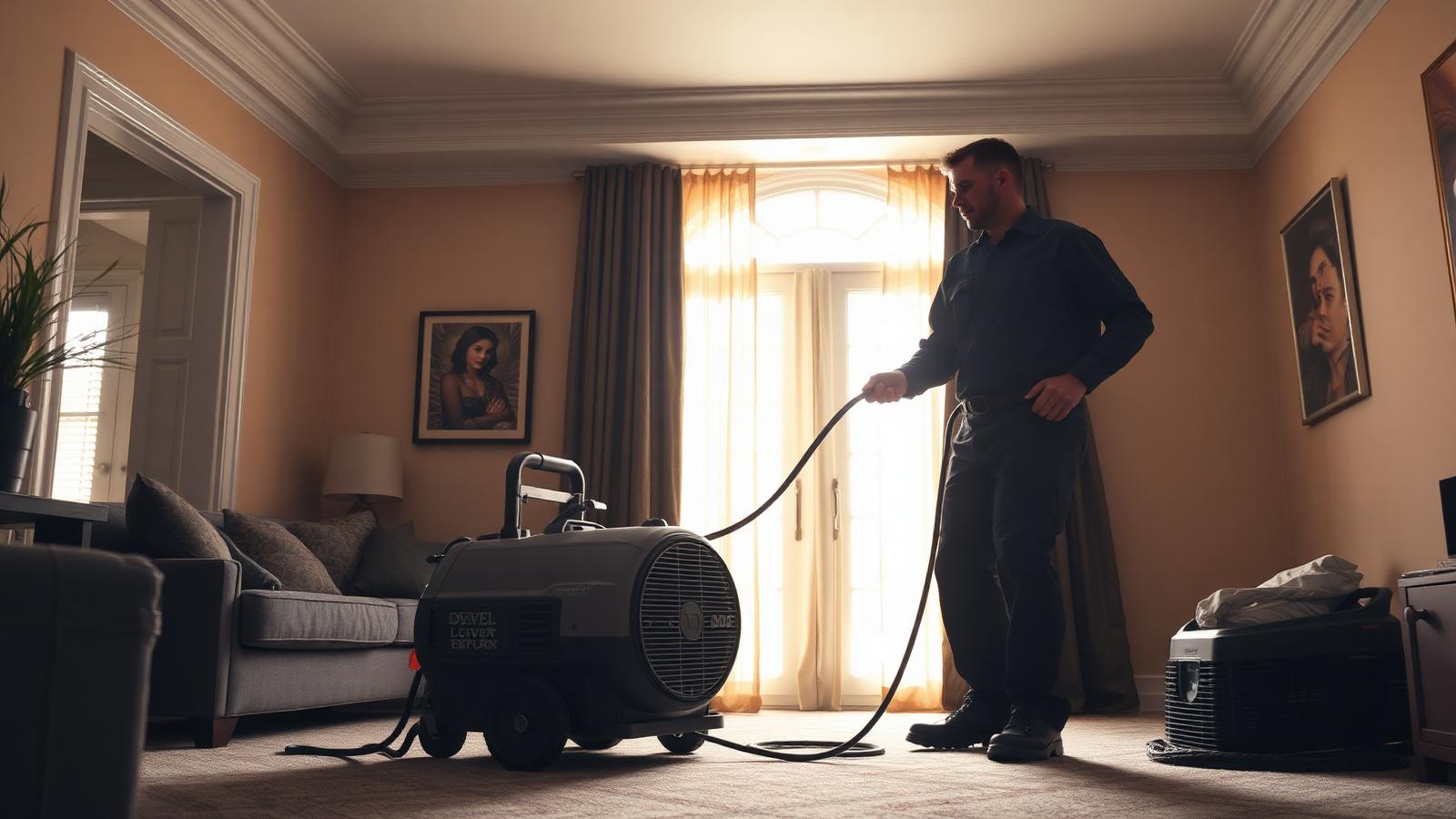
Water Damage Restoration in Suisun City, CA
Rapid extraction, structural drying, and documented moisture control. Performed directly by our own crews for Suisun City homes and businesses.
Water Damage Restoration in Suisun City is shaped by conditions that do not apply evenly across Solano County. Suisun City combines ordinary supply line and appliance failures with an elevated baseline of groundwater and drainage-driven intrusion. Low-lying properties see water in crawlspaces and garages during sustained winter rain, and the high water table means a crawlspace that floods drains slowly, sometimes staying wet for weeks. Waterfront-adjacent properties also see wind-driven rain on exposures that face open water, which puts more water on siding and window assemblies than the same wall would take a few miles inland.
The building stock matters as much as the weather. The Old Town and waterfront district includes the oldest housing stock in our service area, with raised-foundation homes over crawlspaces, original wood siding, and in many cases plumbing and electrical systems that have been modified repeatedly over a century. Crawlspace moisture is the defining issue in this stock, and it is the source of most of the mold work we do in Suisun City. That construction profile changes what we expect to find once an assembly is opened, and it changes the sequence of the work rather than just the paperwork on it.
Suisun City sits at the head of Suisun Slough where it meets the Suisun Marsh, and much of the older city sits at very low elevation, in places only a few feet above sea level. The marsh moderates temperature and raises local humidity, particularly in the mornings and during winter. For water damage restoration specifically, that geography determines both how a loss develops and how quickly a building recovers once mitigation begins.
Suisun City is minutes from our base, so response is effectively the same as Fairfield. We approach Old Town and waterfront properties expecting crawlspace involvement and older-assembly surprises, and we bring the moisture investigation tools to confirm rather than assume.
Suisun City's commercial activity centers on the waterfront district with its restaurants and small retail, the Main Street corridor, marina-related businesses, and light industrial and service uses toward the Fairfield boundary. Waterfront restaurant and retail spaces need fast turnaround because they operate on foot traffic, and their older building assemblies frequently reveal concealed conditions once a wall is opened.
Why Suisun City properties see this loss
Suisun City sits at the head of Suisun Slough where it meets the Suisun Marsh, and much of the older city sits at very low elevation, in places only a few feet above sea level. The marsh moderates temperature and raises local humidity, particularly in the mornings and during winter.
The waterfront district and the streets immediately behind it have the highest groundwater in the county service area. That means crawlspaces stay damp longer, slab moisture transmission is a real consideration, and any drainage deficiency shows up faster than it would in a Fairfield foothill neighborhood.
Newer development on the north and east sides sits higher and behaves more like adjacent Fairfield tract housing, which means the city effectively has two distinct restoration profiles depending on which side of it a property sits on.
Supply line and appliance failures account for a large share of the interior water losses we see. Braided washing machine hoses, refrigerator ice maker lines, dishwasher supply connections, and angle stops under sinks all fail without warning, and they fail while pressurized, which means water keeps coming until someone closes the main. A supply line that lets go while a house is empty for a weekend can put thousands of gallons into a structure.
Drain and sewer backups introduce a different problem, because the water carries contaminants. A backed-up main line, a failed sewer ejector pump, or an overwhelmed lateral during heavy rain produces category three water, which cannot be dried in place the way clean water can. Porous materials it touches have to come out.
Weather-driven intrusion is seasonal here. Solano County gets most of its rain in a compressed winter window, often in atmospheric river events that dump inches in a day. Roof flashing, parapet details, clogged gutters, window head details, and slab edges that manage fine in a normal drizzle will let water in during a sustained downpour driven by wind.
What the work involves
Water damage restoration is not the same thing as water cleanup. Cleanup removes the water you can see. Restoration returns the structure to a dry, stable, pre-loss condition and proves it with measurements. Those are very different scopes of work, and the difference matters because a building that looks dry can still hold enough moisture inside its assemblies to support microbial growth, warp flooring, and delaminate cabinetry weeks after the visible water is gone.
The work breaks into three phases that overlap. Mitigation stops the loss from spreading, which means stopping the source, extracting standing water, and removing materials that cannot be dried in place. Drying pulls the remaining moisture out of framing, subfloor, plaster, and insulation using airflow, dehumidification, and controlled heat. Restoration puts the building back together, from replacing drywall and baseboard through flooring, paint, and finish carpentry.
Running through all three phases is documentation. We record moisture readings at defined points every day the equipment runs, photograph the affected areas before and during the work, log the equipment on site, and produce a scope that an adjuster can read without a translator. That record is what turns a claim conversation from an argument into a review.
Warning signs
- Dark rings or spreading discoloration on ceilings and upper walls
- A persistent musty or earthy smell that does not clear with ventilation
- Paint that bubbles, blisters, or peels away from drywall
- Hardwood that cups, crowns, or separates at the seams
- Laminate or engineered flooring swelling along the joints
- Carpet or pad that stays cool and damp long after a spill should have dried
- Baseboard pulling away from the wall or showing a swollen bottom edge
- An unexplained increase in water usage across more than one billing cycle
Any single one of these is worth investigating. Two or more appearing at the same time in the same part of a building almost always means water has been present long enough to affect materials behind the surface, and a surface inspection alone will not tell you how far it has traveled. Moisture meters and thermal imaging are what settle the question.
Our process in Suisun City
- Step 1Emergency call and source control
We take the call, walk you through immediate safety steps such as shutting the main and cutting power to affected circuits, and dispatch. Stopping the source is always the first physical action on site, because no drying plan works against an active leak.
- Step 2Assessment and moisture mapping
Before equipment goes down, we map the wet area. Moisture meters read framing and subfloor, thermal imaging shows temperature differentials that reveal water inside assemblies, and hygrometers record the ambient conditions. This produces the boundary of the affected area, which is usually larger than the visible one.
- Step 3Extraction
Standing water comes out first with truck or portable extraction units, then weighted extraction pulls water out of carpet and pad. Removing bulk water mechanically is dramatically faster and cheaper than evaporating it, so we extract aggressively before drying begins.
- Step 4Selective demolition
Materials that cannot be dried in place come out in a controlled way. That may mean removing baseboard and drilling weep holes to vent a wall cavity, cutting drywall to a defined height, pulling saturated insulation, or lifting unsalvageable flooring. The goal is the minimum removal that still allows the structure to dry.
- Step 5Structural drying
Air movers create the airflow that moves moisture from materials into the air, and dehumidifiers pull that moisture back out of the air so the cycle continues. Equipment placement, containment, and dehumidifier sizing are calculated for the affected volume rather than guessed at.
- Step 6Daily monitoring and verification
We return each day the equipment runs, take readings at the same mapped points, and adjust placement as the drying curve changes. Equipment comes out when materials reach dry standard measured against an unaffected reference area, not when the schedule says so.
- Step 7Repair and reconstruction
Once the structure is verified dry, we rebuild. Drywall, texture, paint, trim, flooring, and cabinetry are handled by the same company that did the mitigation, which removes the most common point of failure in a water claim, the handoff between the drying company and the builder.
Residential and commercial
In homes, the priorities are containing the disruption and protecting contents. We work room by room where possible, set containment so drying equipment is not conditioning the whole house, and move or block furniture off wet flooring early so it does not stain or absorb. Occupied homes get a walkthrough at the end of each visit so you know what changed and what happens next.
In commercial buildings, the priority is usually keeping the business operating. That means after-hours work when the space cannot be closed, containment that separates the work area from occupied areas, coordination with property management and tenants, and documentation formatted for a commercial carrier. We also plan around the things that shut a business down faster than the water itself, such as inventory, server rooms, and tenant improvements.
Suisun City's commercial activity centers on the waterfront district with its restaurants and small retail, the Main Street corridor, marina-related businesses, and light industrial and service uses toward the Fairfield boundary. Waterfront restaurant and retail spaces need fast turnaround because they operate on foot traffic, and their older building assemblies frequently reveal concealed conditions once a wall is opened.
Local building stock and what it changes
The Old Town and waterfront district includes the oldest housing stock in our service area, with raised-foundation homes over crawlspaces, original wood siding, and in many cases plumbing and electrical systems that have been modified repeatedly over a century. Crawlspace moisture is the defining issue in this stock, and it is the source of most of the mold work we do in Suisun City.
Mid-century tract housing fills much of the area between Old Town and the Fairfield boundary, with the same slab-on-grade construction, aging supply lines, and marginal bathroom ventilation found in central Fairfield.
Post-1990 subdivisions on the north side are conventional two-story tract construction, where second-floor laundry and bathroom failures are the dominant water loss driver.
Timeline and response
A straightforward clean-water loss in a single room typically dries in three to five days of equipment time, with monitoring visits each day. Losses involving multiple rooms, hardwood, plaster, or dense assemblies commonly run five to eight days. Contaminated water and structural saturation take longer, because removal has to happen before drying starts. Reconstruction is scheduled separately and depends on materials and scope. We give you a projected schedule after the first assessment and update it whenever the readings change it.
Suisun City is minutes from our base, so response is effectively the same as Fairfield. We approach Old Town and waterfront properties expecting crawlspace involvement and older-assembly surprises, and we bring the moisture investigation tools to confirm rather than assume.
Insurance and documentation
Most homeowner and commercial property policies cover sudden and accidental water damage. Slow leaks that have been developing over months are frequently excluded, which is one more reason early detection matters. We document the loss thoroughly, provide photographs, moisture logs, equipment records, and a line item scope, and we communicate directly with your adjuster when you ask us to. We do not tell you what your carrier will pay, because that is their decision, and we do not inflate a scope to chase a number.
What affects cost
- Volume of water and how long it sat before extraction began
- Water category, from clean supply water through contaminated sewage
- Materials affected, since hardwood, plaster, and dense insulation dry slowly
- Square footage and number of rooms requiring equipment
- Whether contents need to be moved, protected, or packed out
- Scope of reconstruction required after drying is verified
Preventing a repeat
- Replace rubber washing machine hoses with braided stainless steel on a five year cycle
- Learn where your main shutoff is and confirm it actually turns before you need it
- Install pan sensors or leak detectors under water heaters, dishwashers, and laundry
- Clear gutters and check roof flashing before the first substantial winter storm
- Check angle stops under every sink and toilet twice a year for corrosion or dampness
Keep exploring
Answers to common questions
Water Damage Restoration in Suisun City, done right
We perform the work ourselves, we document it for your carrier, and we tell you plainly what does and does not need to be done. Trusted since 2005.