
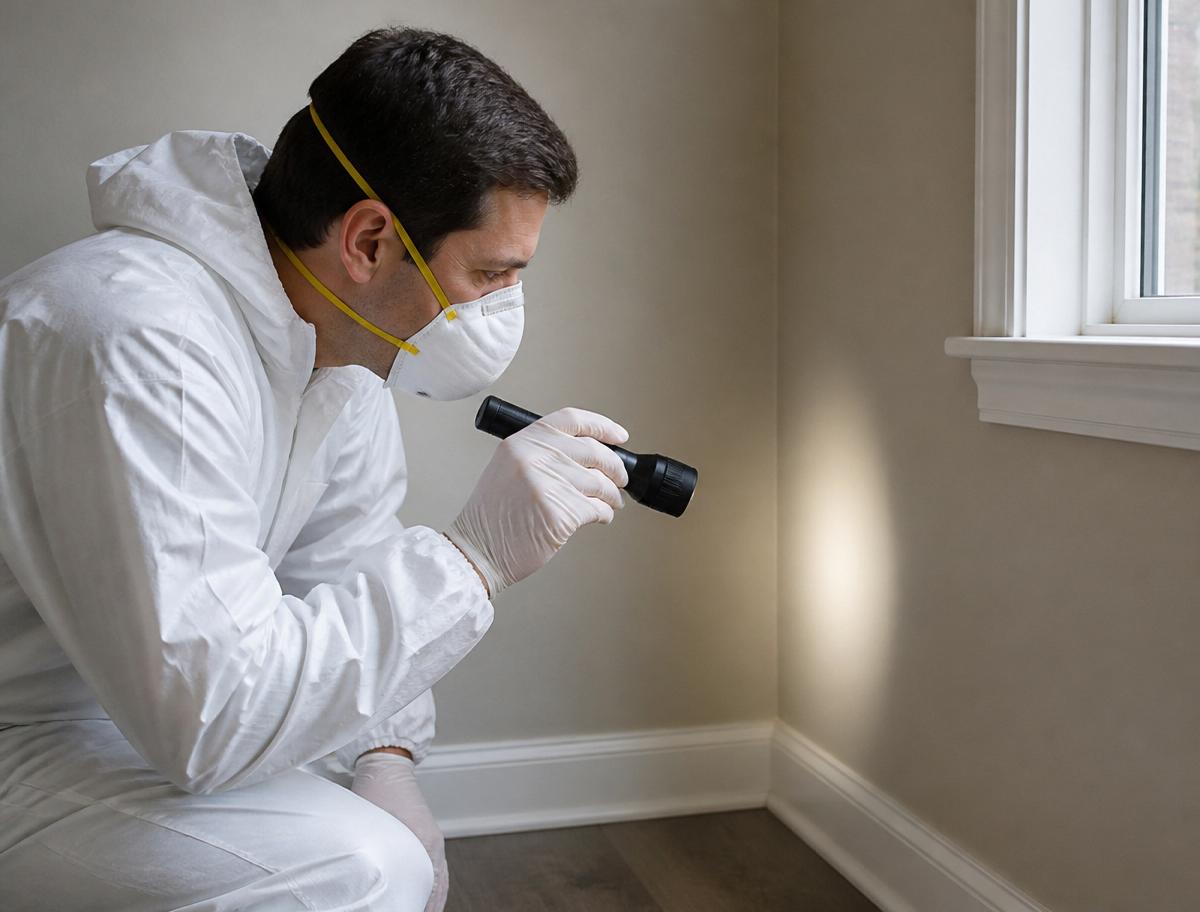
Mold Remediation in Fairfield, CA
Containment, safe removal, and correction of the moisture source. Performed directly by our own crews for Fairfield homes and businesses.
Mold Remediation in Fairfield is shaped by conditions that do not apply evenly across Solano County. The Delta breeze and dry summers mean Fairfield is not a chronically humid climate, and that is generally protective. The mold problems we find here are almost always tied to a specific moisture source rather than to ambient conditions. The recurring culprits are unresolved winter water intrusion in attics and exterior walls, bathrooms without functioning exhaust ventilation in the mid-century stock, crawlspaces that hold standing water after a wet winter, and slab leaks that soak subfloor and wall base for months before discovery. Because the ambient air is dry, homeowners frequently assume they cannot have a mold problem, which is exactly why these situations run long before anyone investigates.
The building stock matters as much as the weather. Central Fairfield includes a substantial stock of mid-century homes built between the 1950s and 1970s, much of it tied to Travis Air Force Base growth. These homes commonly have original cast iron or galvanized drain lines nearing the end of their service life, slab-on-grade construction with copper supply lines that develop pinhole leaks, single-pane or early dual-pane windows with failing seals, and minimal attic insulation by current standards. That construction profile changes what we expect to find once an assembly is opened, and it changes the sequence of the work rather than just the paperwork on it.
Fairfield sits in the Suisun Valley basin, bounded by the Vaca Mountains to the north and west and the Suisun Marsh to the south. That position produces the single most defining local weather feature, the Delta breeze, which funnels marine air inland through the Carquinez and Suisun gaps almost every summer afternoon and drives sustained wind through winter storm systems. For mold remediation specifically, that geography determines both how a loss develops and how quickly a building recovers once mitigation begins.
Fairfield is where our crews and equipment are based, which means the shortest mobilization time we offer anywhere. Interstate 80 and Highway 12 give us direct access to nearly every part of the city, and we know which neighborhoods have access constraints, which have older infrastructure, and which sit low enough that storm season deserves a proactive look.
Fairfield's commercial base includes the Solano Town Center retail corridor, the Green Valley and Cordelia business parks, food and beverage manufacturing including the well-known operations off Highway 12, medical and professional offices, and a substantial hospitality cluster serving Interstate 80 traffic. Each has its own restoration priority. Retail cares about reopening floor area, food production cares about contamination control and documentation, offices care about records and workstations, and hospitality cares about getting rooms back in inventory. We phase commercial work around whichever of those drives the loss.
Why Fairfield properties see this loss
Fairfield sits in the Suisun Valley basin, bounded by the Vaca Mountains to the north and west and the Suisun Marsh to the south. That position produces the single most defining local weather feature, the Delta breeze, which funnels marine air inland through the Carquinez and Suisun gaps almost every summer afternoon and drives sustained wind through winter storm systems.
The city drains toward Suisun Slough through a network of creeks including Ledgewood Creek, Laurel Creek, and Union Avenue drainage channels. In an ordinary rain year those channels handle runoff without incident. In an atmospheric river event, where several inches fall in a day onto ground already saturated from the previous storm, low-lying areas near those channels and older neighborhoods with undersized storm drains see water where it does not normally go.
Elevation varies more than people expect for a valley city, from near sea level at the marsh edge to several hundred feet in the foothill neighborhoods on the northwest side. That range means two properties a few miles apart can face completely different water intrusion and wildfire exposure profiles.
Unresolved water losses are the leading cause. A leak that was mopped up and left to dry on its own leaves framing, insulation, and subfloor wet, and those materials hold moisture for weeks in an enclosed cavity.
Chronic low-grade moisture creates the slowest and most widespread problems. Failing window seals, a slab without a functioning vapor barrier, a crawlspace with standing water, or a bathroom without working ventilation produce conditions that never dry out and never announce themselves.
Condensation from HVAC and building envelope issues drives mold in ways owners rarely suspect, particularly on air handler cabinets, supply registers, uninsulated ducts in unconditioned attics, and interior faces of poorly insulated exterior walls.
What the work involves
Proper remediation starts with containment. Disturbing mold releases spores, and a job done without containment spreads a localized problem through the whole building. Containment means physical barriers, negative air pressure inside the work area, HEPA filtration scrubbing the air, and controlled entry and exit so spores do not ride out on foot traffic.
Removal follows containment. Porous materials with growth through them, such as drywall, insulation, carpet pad, and particle board, come out rather than getting cleaned, because cleaning the face of a porous material does nothing about what is inside it. Semi-porous and non-porous materials such as framing, concrete, and metal can usually be cleaned and treated in place using HEPA vacuuming, wire brushing or sanding where appropriate, and antimicrobial application.
The final phase is drying and verification. The affected assembly is dried to standard, the containment is cleaned, air scrubbing continues through the final cleaning, and post-remediation verification confirms conditions before the area is rebuilt. Then, and only then, the moisture source correction is confirmed as complete.
Warning signs
- A persistent musty or earthy odor with no visible source
- Visible growth on drywall, framing, grout, or the back of baseboard
- Discoloration that returns after cleaning or repainting
- Condensation on windows, ducts, or interior walls in cool weather
- Allergy or respiratory symptoms that improve when occupants leave the building
- Warped or bulging drywall and soft spots at the base of walls
- Any known past water event that was dried informally or not at all
Odor without visible growth is common and it is not a reason to wait. Growth in a wall cavity, under flooring, or behind cabinetry produces smell long before anything appears on a painted surface, and by the time it is visible the affected area is generally well established.
Our process in Fairfield
- Step 1Inspection and moisture investigation
We find the water before we touch the mold. Moisture meters, thermal imaging, and inspection of the likely paths establish where the water is coming from and how far the affected area extends.
- Step 2Containment setup
Physical barriers, sealed openings, negative air machines with HEPA filtration, and a controlled entry establish a work area that will not contaminate the rest of the building.
- Step 3Air filtration
HEPA air scrubbers run throughout the work, capturing airborne spores released during removal and maintaining the pressure differential that keeps the containment working.
- Step 4Removal of affected materials
Porous materials with growth are cut out to a defined boundary beyond the visible edge, bagged inside containment, and removed through the controlled exit rather than carried through the building.
- Step 5Cleaning and antimicrobial treatment
Remaining framing and non-porous surfaces are HEPA vacuumed, cleaned, treated with an appropriate antimicrobial, and where called for sealed. Adjacent surfaces inside containment get the same treatment.
- Step 6Drying and moisture source correction
The assembly is dried to standard and the source is corrected, whether that means a plumbing repair, flashing correction, drainage change, ventilation improvement, or vapor barrier work. Skipping this is the single most common reason mold returns.
- Step 7Verification and rebuild
Conditions are verified before containment comes down, then insulation, drywall, texture, paint, trim, and flooring go back in.
Residential and commercial
In homes, occupant health and disruption are the drivers. We contain tightly, schedule around occupancy where the affected area allows it, discuss when temporary relocation is genuinely warranted, and handle bathrooms, laundry areas, crawlspaces, and attics, which is where most residential growth lives.
In commercial buildings, mold quickly becomes a tenant relations and liability question. We work after hours where needed, keep containment presentable in occupied buildings, document the scope and verification for property management and legal records, and coordinate with facility staff on HVAC operation during the work.
Fairfield's commercial base includes the Solano Town Center retail corridor, the Green Valley and Cordelia business parks, food and beverage manufacturing including the well-known operations off Highway 12, medical and professional offices, and a substantial hospitality cluster serving Interstate 80 traffic. Each has its own restoration priority. Retail cares about reopening floor area, food production cares about contamination control and documentation, offices care about records and workstations, and hospitality cares about getting rooms back in inventory. We phase commercial work around whichever of those drives the loss.
Local building stock and what it changes
Central Fairfield includes a substantial stock of mid-century homes built between the 1950s and 1970s, much of it tied to Travis Air Force Base growth. These homes commonly have original cast iron or galvanized drain lines nearing the end of their service life, slab-on-grade construction with copper supply lines that develop pinhole leaks, single-pane or early dual-pane windows with failing seals, and minimal attic insulation by current standards.
The 1980s through early 2000s expansion produced large tract neighborhoods on the north and east sides. These homes tend to have two-story layouts with upstairs laundry rooms and bathrooms, which is the specific configuration that turns a supply line failure into a two-floor loss, and they frequently have builder-grade angle stops and washing machine hoses that were never replaced.
Newer construction in Fairfield is tighter and better insulated, which is good for energy performance and creates a different moisture profile. A tight building that gets wet dries more slowly without mechanical intervention, and interior humidity from ordinary occupancy has fewer paths out, so bathroom ventilation performance matters far more than it did in a leaky 1960s house.
Timeline and response
A small contained area, such as a single bathroom wall, is often a two to four day job including drying. Larger areas or multiple rooms run one to two weeks. Crawlspace and attic remediation depends heavily on access. Moisture source correction can add time when it involves roofing, plumbing, or drainage work, and reconstruction is scheduled after verification.
Fairfield is where our crews and equipment are based, which means the shortest mobilization time we offer anywhere. Interstate 80 and Highway 12 give us direct access to nearly every part of the city, and we know which neighborhoods have access constraints, which have older infrastructure, and which sit low enough that storm season deserves a proactive look.
Insurance and documentation
Mold coverage varies widely by policy and is frequently limited or capped, especially where the underlying moisture was long-term rather than sudden. Where mold results directly from a covered water loss, coverage is more common. We document the moisture source, the affected area, the removal scope, and verification, and we are straightforward with you about what is likely to be a covered line and what is likely to be out of pocket.
What affects cost
- Square footage of affected material and number of separate containment areas
- Accessibility, since crawlspaces and attics take significantly more labor
- Whether framing can be cleaned in place or requires replacement
- The nature of the moisture source correction required
- Whether contents need cleaning or disposal
- Reconstruction scope after verification
Preventing a repeat
- Run bathroom exhaust fans during and for twenty minutes after every shower
- Keep interior relative humidity below sixty percent, and below fifty where possible
- Address any water event within twenty four to forty eight hours, always
- Inspect crawlspaces annually for standing water, wet insulation, and vapor barrier gaps
- Insulate ducts and cold water lines that run through unconditioned space
Keep exploring
Answers to common questions
Mold Remediation in Fairfield, done right
We perform the work ourselves, we document it for your carrier, and we tell you plainly what does and does not need to be done. Trusted since 2005.